A Week on the Hooghly Aboard ABN Rajmahal

The Hooghly is best known as the wide brown river beneath Howrah Bridge, the waterway that carried East India Company ships up to Calcutta. Far fewer travellers know what lies upstream. A Hooghly river cruise with Assam Bengal Navigation follows the river north from Kolkata for seven nights, past the old trading towns of the Portuguese, Dutch, Danes, French and British, through the former capital of the Nawabs of Bengal and on to Farakka, where the river draws its water from the main stream of the Ganges.
The usual idea of a Kolkata river cruise is an hour on the water at sunset.

Category

Tour

Words by

Marée & Meridian

Published

October 5, 2026

This one keeps going for a week, through a stretch of Bengal that India river tours tend to overlook, with its terracotta temples, colonial churches and a battlefield that changed the course of Indian history. Assam Bengal Navigation, founded as a partnership between Indian and British families, became the first operator to run cruises on the Hooghly in 2007 and still sails the route today.

Casting Off from Kolkata

Guests are picked up from their hotels in Kolkata in the morning and are aboard by midday. Within a few hours of starting the Hooghly river cruise, the city thins out into a riverside of old jute mills, bathing ghats (the broad stone steps that lead down to the water) and wooden fishing boats. The first afternoon passes Serampore, which Denmark sold to the British in 1845, before the ship puts in at Barrackpore for a walk through the old cantonment, past the Semaphore Tower, Government House, Flagstaff House and the Temple of Fame.
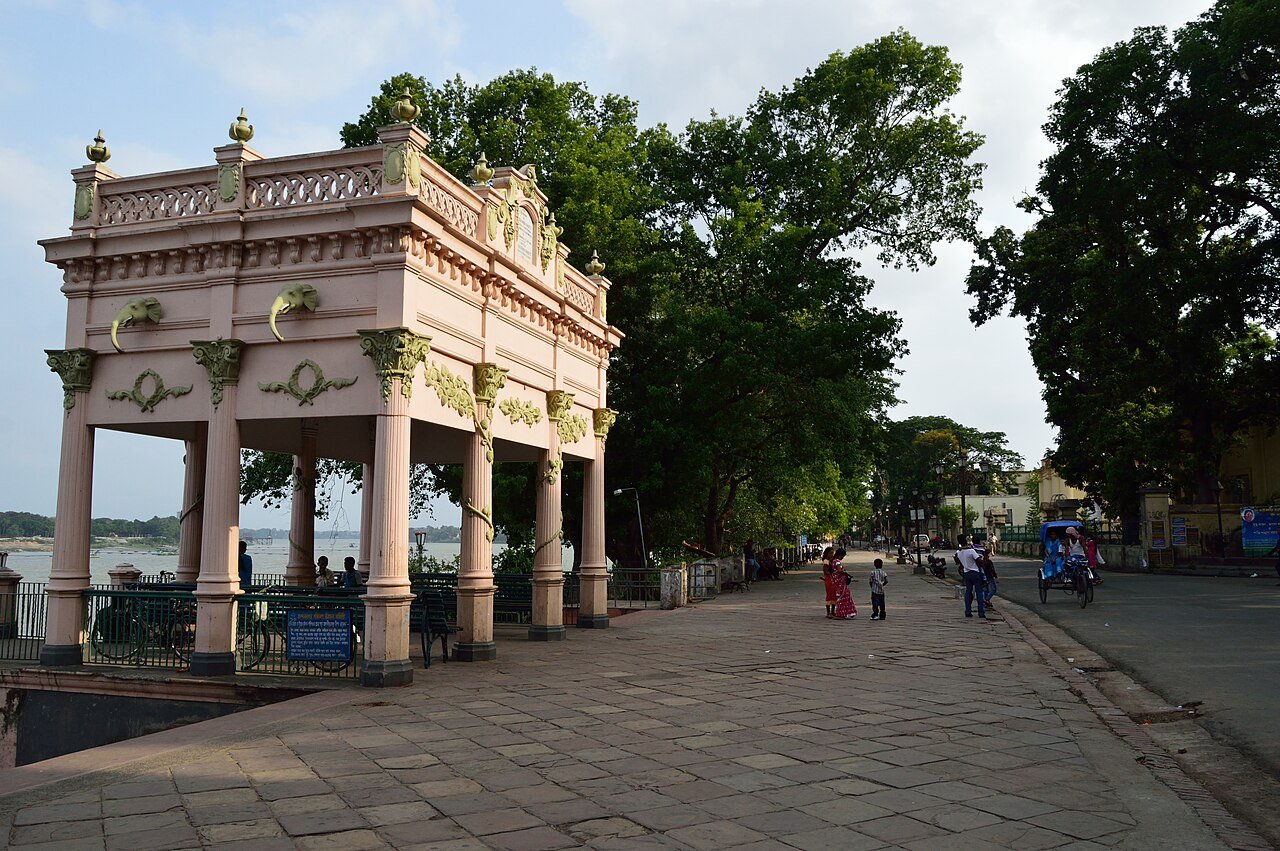
Ornate pavilion on the Chandernagore Strand promenade beside the Hooghly River in West Bengal
The riverside promenade at Chandernagore, laid out while the town was still French.

Evening brings the ship to Chandernagore, one of the highlights of any Hooghly river cruise, where French administration outlasted the British Raj by a few years. The next morning is spent at its French church and the Dupleix Palace, once the residence of Joseph François Dupleix, who went on to govern French India from Pondicherry. Upstream lies Chinsura, held by the Dutch until 1825, and then the town of Hooghly, where the walls of the great Imambara are lettered with verses from the Quran. It is a striking building, and a reminder that the European traders arrived in Bengal with centuries of Islamic history already behind it.
“Travelling upstream, the ship moves steadily against the current, so the riverbank passes slowly enough to take in properly. Temples, ghats and small riverside towns come into view one at a time and stay in sight for a while.”

That night the ship sails on, and the next morning finds her anchored near Kalna.
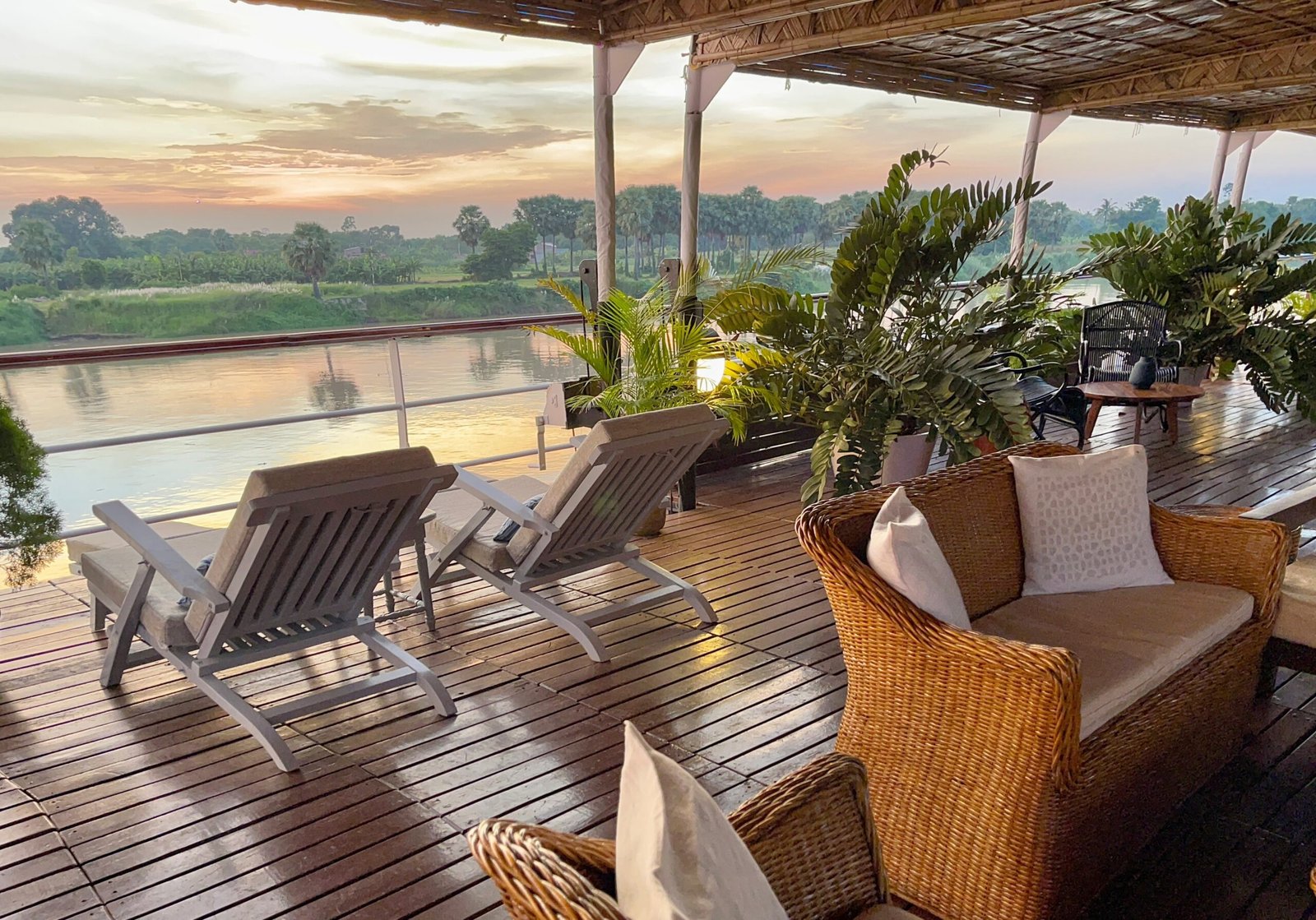
Canopied sundeck of ABN Rajmahal at sunset with loungers and wicker sofas on a Hooghly river cruise
Afternoons on board are spent on the sundeck, with the riverbank going slowly past.

Life Aboard ABN Rajmahal

ABN Rajmahal entered service in 2014, designed specifically for the water levels of the Ganges and the Hooghly river cruise route. She is a small ship by any cruising standard, with 22 cabins in all. Eighteen are twin or double, and the remaining four are singles, a detail solo travellers will appreciate. Every cabin has a French balcony, so the river is always in view throughout the Hooghly river cruise, and the interiors draw on Bengal itself, with cotton fabrics printed by hand from wooden blocks, Bengali antiques and furniture made locally.
Beyond the cabins lie a saloon and bar, a dining room and a canopied sundeck, which is the best seat on board once the ship is under way. The ship moors against the open riverbank, and excursions begin with a gangplank. On some nights she carries on sailing after dark to reach the next mooring, and breakfast comes with a new view.

“Most days follow a simple pattern of a morning ashore, a few hours on the water and an evening mooring somewhere new. It soon becomes an easy and very comfortable way to travel.”

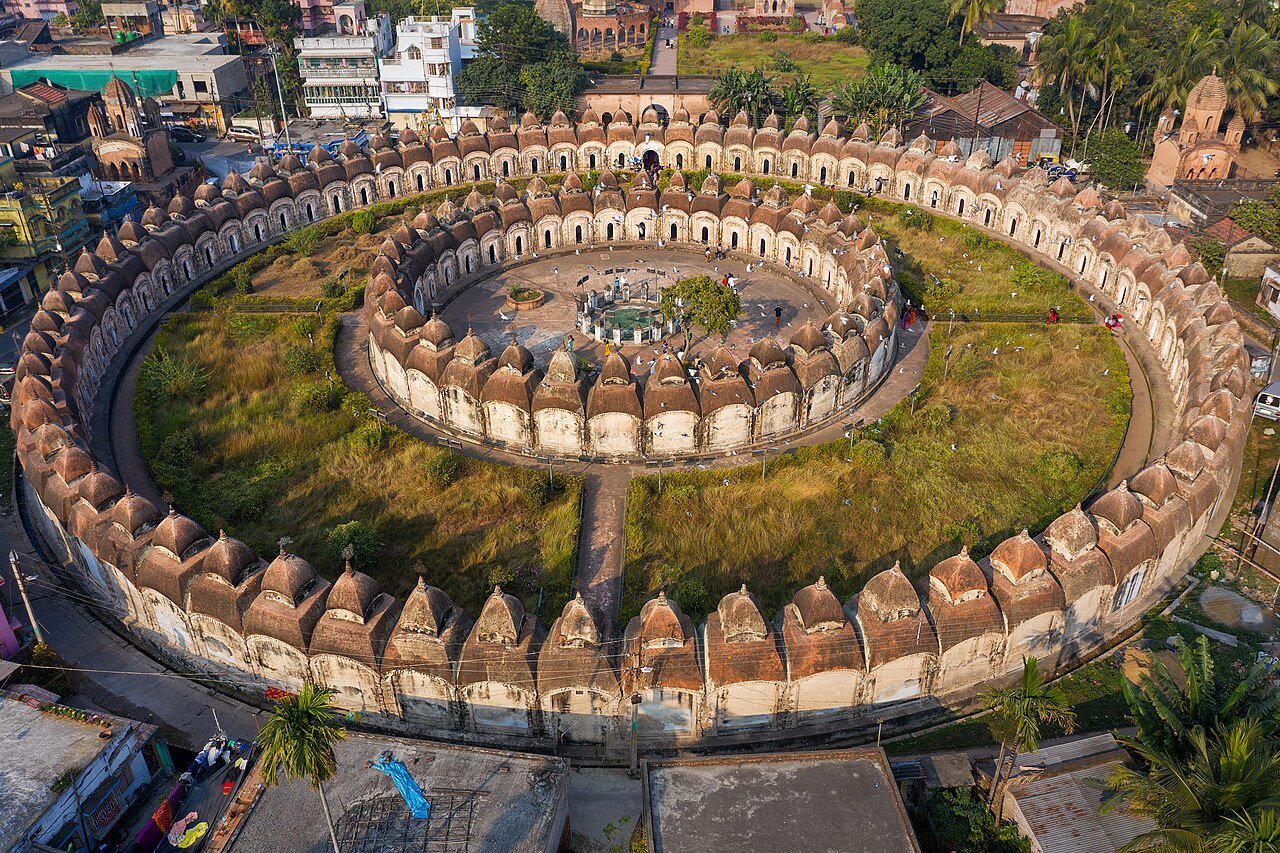
Aerial view of the 108 Shiva Temples at Kalna arranged in two concentric rings
Two rings of shrines at Kalna, best understood from above.

Going Ashore by Rickshaw and on Foot

At Kalna, rickshaws carry guests through the town to some of the most striking terracotta temples in Bengal, their brick walls covered in fired clay panels of gods, epic battles and village life. The most unusual is a Shiva temple complex of 108 small shrines set in two concentric rings. The day also takes in a muslin weaving centre before moving on to Mayapur.
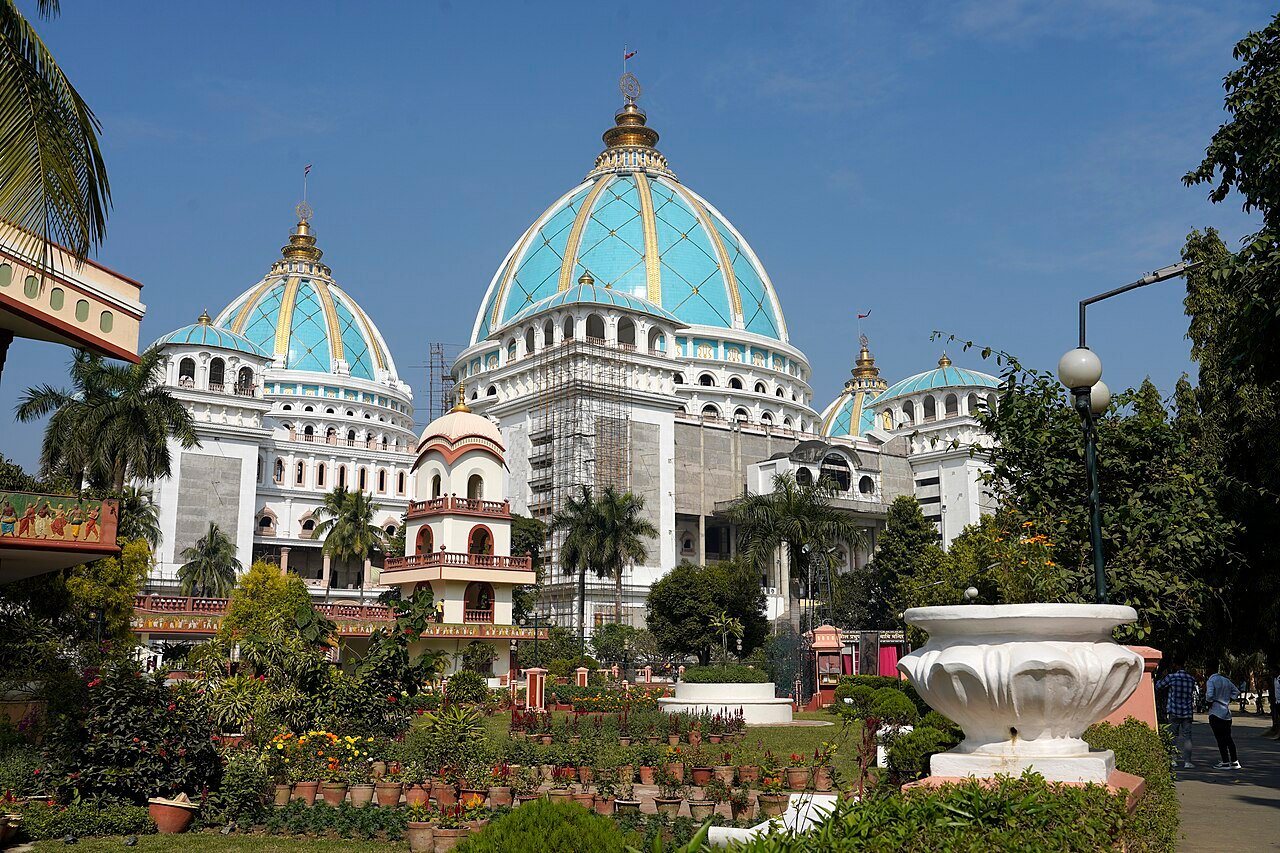
Mayapur comes as a surprise. The world headquarters of the Hare Krishna movement sits here in rural Bengal, and its vast new temple towers over the surrounding fields. The town is revered as the birthplace of Chaitanya Mahaprabhu, a saint of the 15th century at the heart of the movement, and more than a million devotees arrive every year, many of them singing and dancing as they go.
Blue and white domes of the ISKCON temple at Mayapur surrounded by gardens
The temple at Mayapur, headquarters of a movement with followers on every continent.

“A good part of the week is spent on foot, walking through fields to village temples or along the lanes of country towns. These walks give a close, everyday view of rural Bengal, at a pace that suits it.”

The following morning is spent in Matiari, a riverside village of brassworkers, where water pots and other vessels are still beaten out by hand. It sits well off the usual tourist routes of India, and a ship reaches it with ease. Travellers drawn to the artisan villages of Bengal can explore more of them on a longer journey.
Plassey and the Nawabs of Murshidabad

Later that day comes Plassey. On 23 June 1757, Robert Clive’s East India Company army defeated Siraj ud Daulah, the last independent Nawab of Bengal, in a battle that lasted a single day and turned less on fighting than on betrayal. Mir Jafar, the Nawab’s own commander, kept his troops out of the action, and a downpour soaked the Nawab’s gunpowder while the British kept theirs dry. Within a decade, the Company was collecting the revenues of Bengal. For a battle that redrew the map of India, Plassey leaves surprisingly little behind. A memorial obelisk stands among the fields.
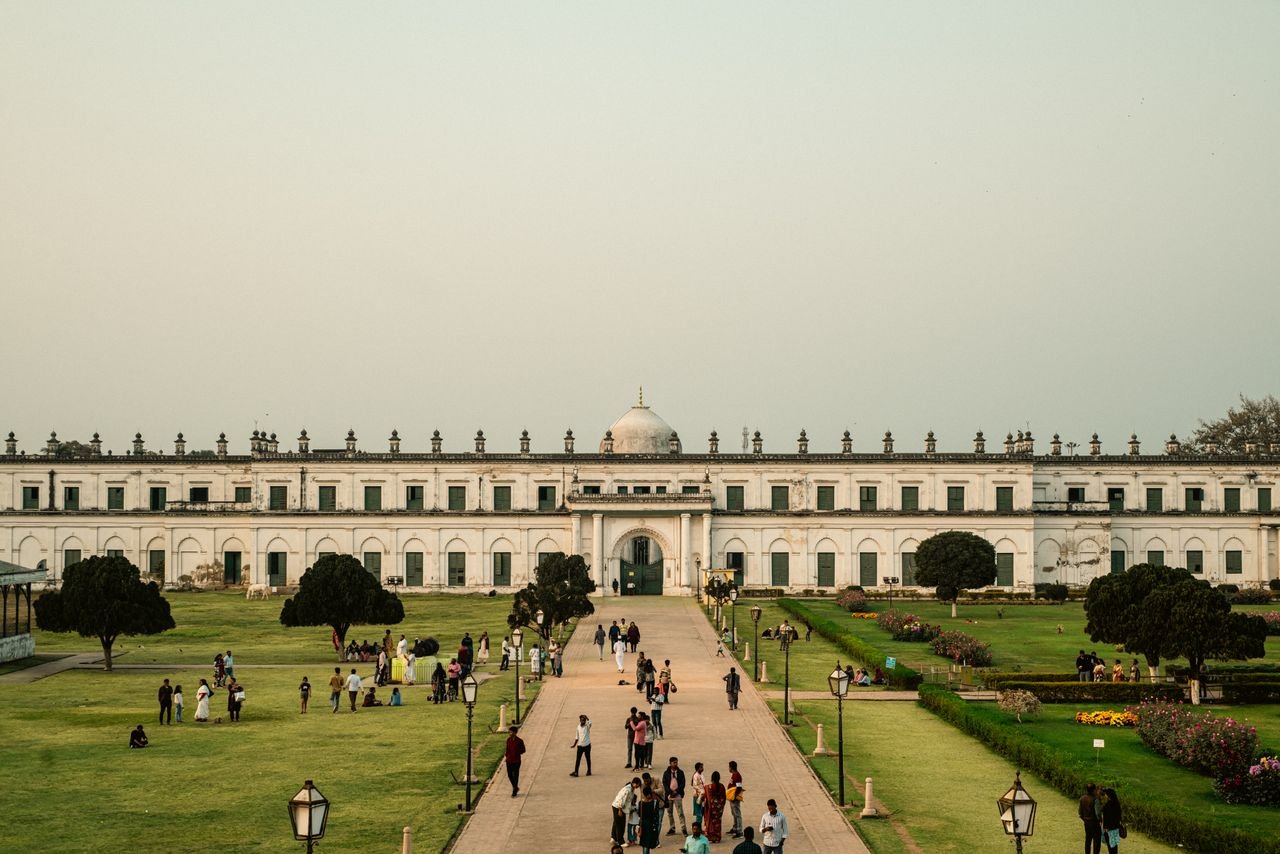
Hazarduari Palace in Murshidabad with its long white facade and central dome
Hazarduari Palace, built for the Nawab and now a museum open to anyone who walks up the drive.

The next morning belongs to Murshidabad, the highlight of any Murshidabad river cruise and capital of Bengal for much of the 18th century. At Khushbagh, a Mughal garden across the river from the city, Siraj ud Daulah lies buried with his family. A little farther upstream, Hazarduari Palace fills the waterfront. Its name means “a thousand doors”, and it was completed in 1837 in grand European style for the Nawab of the day. It now houses a collection of paintings, china and weapons.
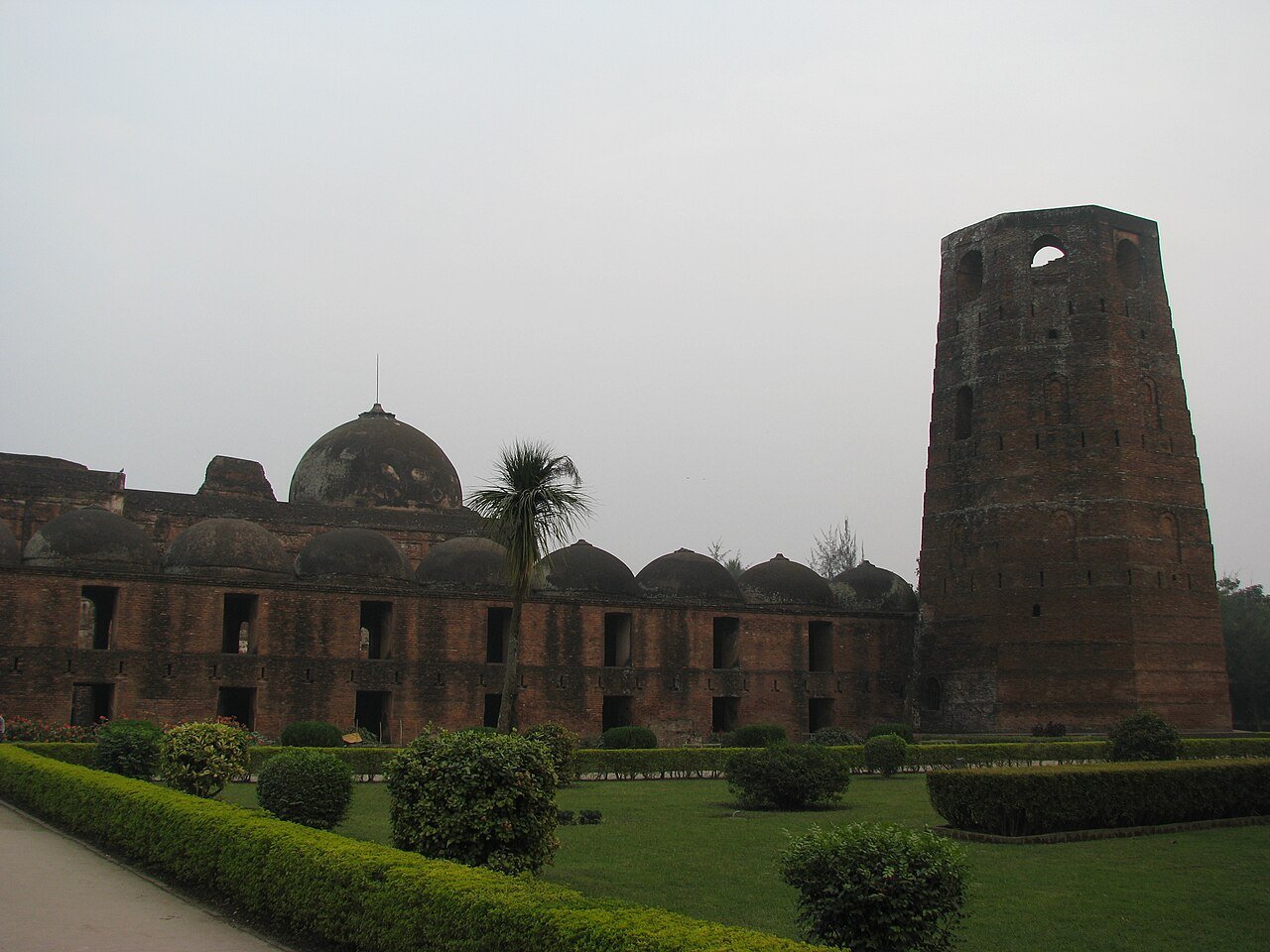
The Katra Mosque has the better story. Murshid Quli Khan, the first Nawab of Bengal, who moved the capital here from Dhaka, lies buried beneath its entrance stairs so that every worshipper would walk over him. It is an unusual act of humility from a man whose name the city still carries.
A short drive away, Katgola Palace, built in the Georgian manner by wealthy merchants, shows the other side of an era when English and Indian tastes came close to merging. The ship spends the night across the river at Baranagar.
Brick facade and domes of the Katra Mosque in Murshidabad with its tall corner tower
The Katra Mosque at Murshidabad, built as a mosque, a resting place for travellers and a tomb.

The Last Stretch to Farakka

The Hooghly is a distributary of the Ganges, carrying part of the great river’s water south to the Bay of Bengal, which is why ABN lists this route among its Ganges river cruise itineraries. Around Murshidabad it goes by yet another name, the Bhagirathi.
The morning starts with a walk through the fields of Baranagar to its small terracotta temples, and rural Bengal rarely looks gentler.

Upstream, the river turns into a winding waterway between mango orchards and mustard fields, bright yellow in winter. The final section follows a long canal to a mooring near the Farakka Barrage, completed across the Ganges in 1975 to send water down into the Hooghly and keep Kolkata’s port open to shipping.
“The hours between stops are part of the journey too. With nothing on the schedule, the sundeck is the natural place to spend them, watching farmland, fishing boats and riverside villages go by.”

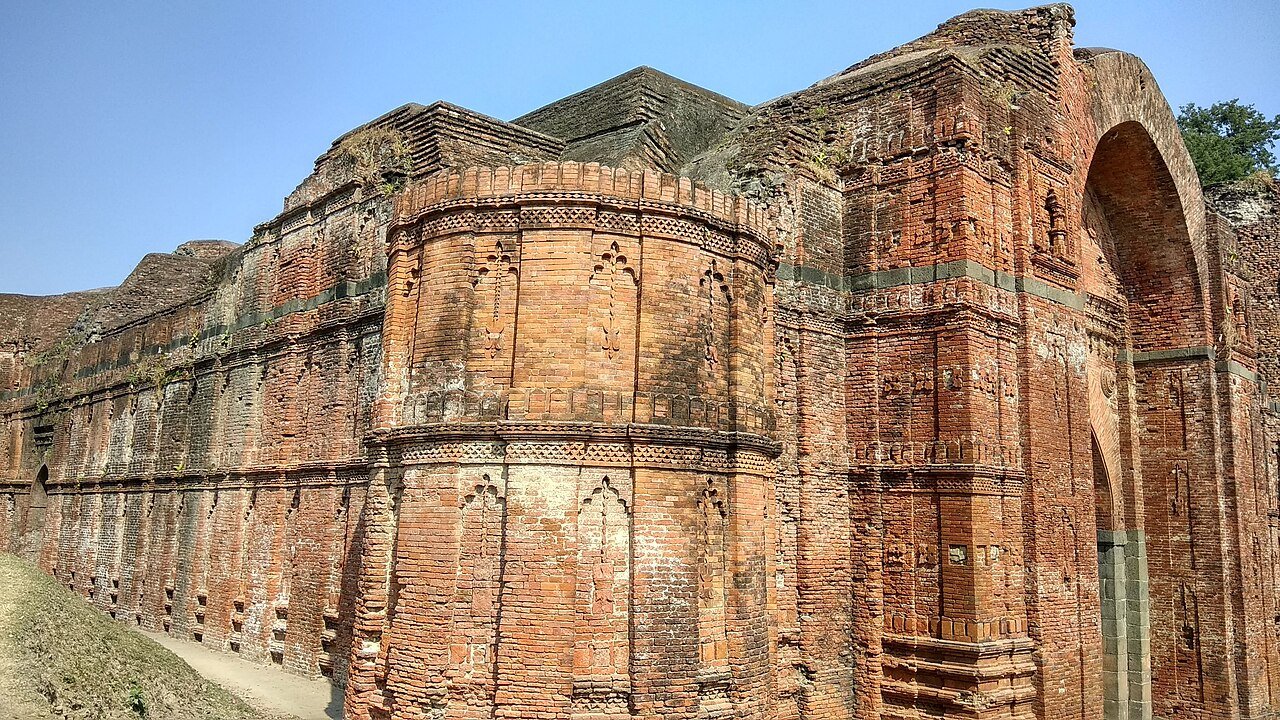
Carved red brick walls of a medieval monument at Gaur near Malda in West Bengal
The brickwork at Gaur, carved and moulded before the city was left to the fields.
The last full day is spent ashore, with a drive to Gaur, near the town of Malda. Under Hindu kings in the 12th century and the sultans of Bengal in the centuries that followed, it ranked among the great cities of India. Its mosques, palaces and gateways now stand scattered across open country, and they are well worth the journey.
On the final morning, a train from Farakka returns guests to Kolkata in about four hours, a slightly humbling figure after a week spent sailing the other way.

Planning a Hooghly River Cruise

This Ganges River cruise suits travellers more interested in what lies along the riverbank than in entertainment on board. Excursions involve walking, rickshaw rides and the occasional drive; the days are leisurely spent, and with only 22 cabins, the numbers on board stay small. It makes a strong case for the Hooghly’s place among the great India river tours, and what begins as a Kolkata river cruise ends, a week later, in a very different Bengal.
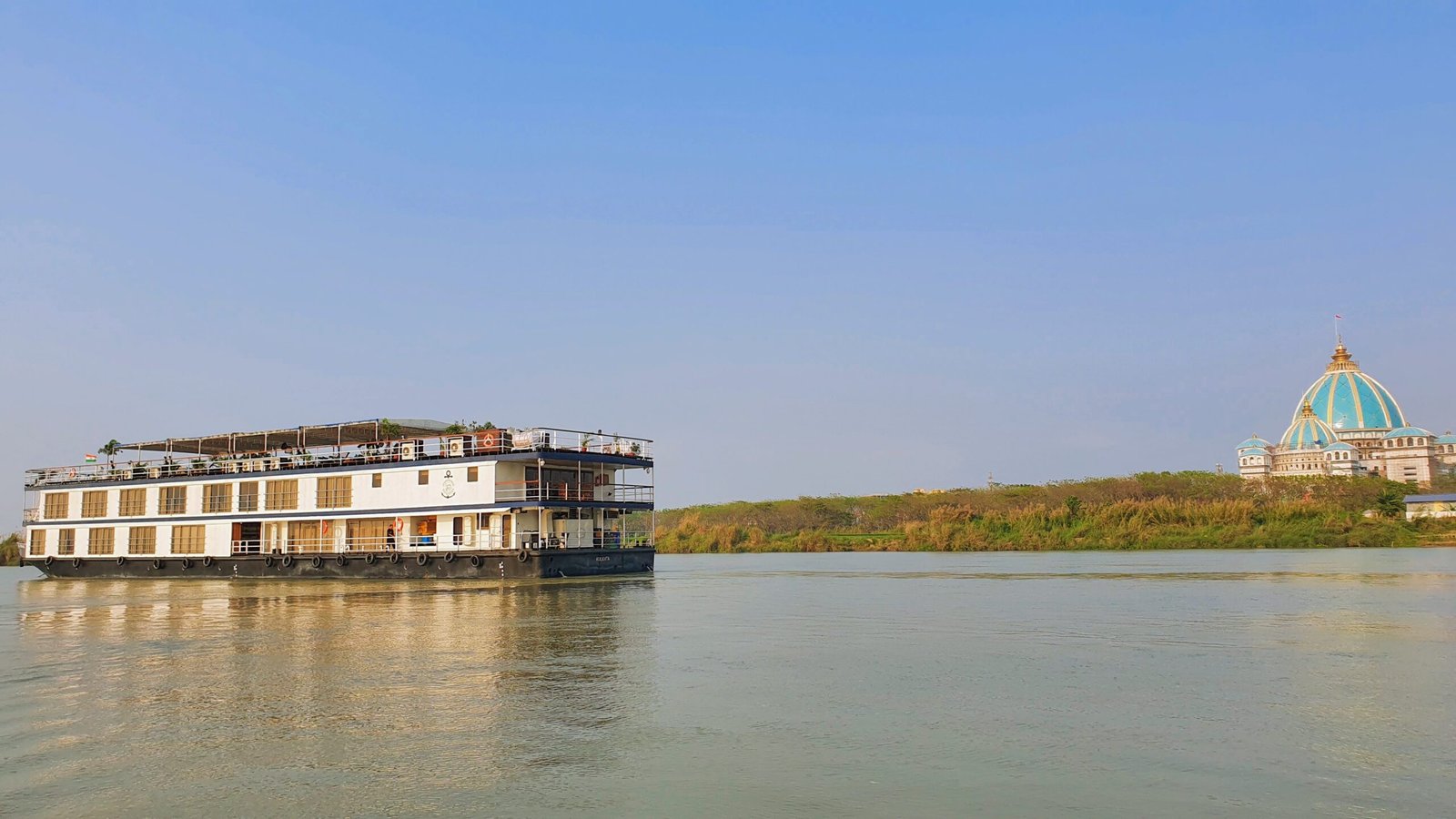
ABN Rajmahal river cruise ship sailing the Hooghly with the Mayapur temple domes in the distance
The ship comes within sight of the Mayapur temple domes as it continues upstream.

“Like every river itinerary, this one depends on water levels and weather, so timings and moorings can shift a little from day to day. That flexibility is part of what makes it feel like a river journey and not a tour run to a fixed timetable.”

If a week on the Hooghly sounds like your kind of journey, our team at Marée & Meridian would love to hear from you. Get in touch, and we will happily talk you through dates and cabins.
Share this story: